The yellow-striped caecilian (Ichthyophis beddomei) is perhaps the weirdest amphibian you will see all day. It’s from the order Gymnophiona and is also called the Beddome’s caecilian and the yellowbelly ichthyophis.
Distributed widely in the jungles of the Western Ghats, I. beddomei is very cuddly and cute and deserves lots more attention. :) They are primarily aquatic though they do like to slither along land. They can be kept as pets (I WANT ONE OMG).
They eat all sorts of things and lay clutches of weird chickenlike eggs. Please do not fry these eggs, as I. beddomei is awesome.
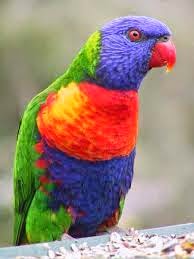
Rainbow lories (Trichoglossus haematodus) are stunning Australasian parrots from Australia (gasp!), Indonesia, Tasmania, New Guinea, Papua New Guinea, New Caledonia, Vanuatu, and the Solomon Islands. They have been introduced to Perth (Purrrrth if you’re a cat), Auckland in New Zealand, and Hong Kong.
This species has twelve subspecies in total, and they do not have any immediately noticeable sexually dimorphic (different coloration, size, etc. in the two genders) traits, but males do have more orange on their breasts and is more stocky and robust, with a more square head.
Shockingly, the beautiful tie-dye birdehz you perceive above are PESTS! Um, WHAT? This is because they eat large amounts of crops and fruit that are grown commercially.
I still consider these beautiful parrots as an awesome thing to see at a zoo. Australian farmers may not agree with me, but wutewa*. (I spelled that right! See? Yes.)
*Whatever.
This beautiful creature is a jewel wasp (Ampulex compressa), aka an emerald cockroach wasp. It is so-called because it attacks insects—usually a type of cockroach called Pariplaneta americana— and stings their brains, then lays eggs inside the still-living cockroach. The young baby jewel wasps live inside the cockroach and control its brain and slowly eat the insides of the cockroach.
EWW! What?!?
I’m sorry you read that, and I’m shocked I was so…so calm about it.
Jewel wasps live all over Africa, South Asia, and the Pacific islands. The female is about 2.2 cm (22 mm) and the male is slightly smaller and lacks a stinger.
The whole “babies control bugs’ brains” thing reminds me a lot of a tropical fungus called Cordyceps, which does exactly the same thing, but it grows out of the insect (usually an ant)’s head. The weird part is that Cordyceps fungi are made into a Chinese soup called “silkie”, which also contains seahorses (Hippocampus).
Did you know there are 54 species of seahorses in the world? Find out more about the dwarf seahorses in the on December 12!
Meet the absolutely amazing variable beautymark (Rhetus periander), also known as the periander metalmark. It’s lovely and beautiful and extremely colorful. It is from the Riodinidae family of butterflies.
The variable beautymark’s range is found in much of Central and South America, from Mexico down to Brazil and Argentina. Its habitat is lush, wet rainforests where it eats the rotting carcasses of dead tarantulas.
Wait. What was that last bit?
Yep. It’s true. Variable beautymarks absolutely guzzle dead tarantulas, which is extremely disgusting and depressing. :(
PS: 40th post already, and I published the 30th just four days ago. WHAT.
This is the small California grunion (Leuresthes tenue), which can grow to a slightly surprising 7½ inches (19 cm). It lives in…
California! Ha. I’m so smart.
They are related to rainbowfish (Bedotiidae and Melanotaeniidae), which is slightly odd, as they look nothing alike. They also are related to the topsmelt (Atherinops affinis).
They remind me a lot of pigs (Sus spp.) because of the fact that they like to roll in the mud on the beach! :) Cute. Until you realize they’re laying eggs.
Moving on.