Showing posts with label beautiful. Show all posts

February 09, 2015

IT EATS STARFISH!


Nomming on a starfish
This is the harlequin shrimp (Hymenocera elegans), a saltwater shrimp that lives on coral reefs in the Pacific and Indian oceans, typically in Hawaii.

They like a warm temperature of 72° - 82°F.

But the best thing about these shrimp is their diet.

As in the last picture above, it’s eating a starfish! (Which is fine by me because I don't like starfish. SPECIESISM)

Er, sorry, starfish fans…I just hate them. With a passion.

They are not to be confused with the freshwater Sulawesi shrimp (Caridina spongicola), which looks like this:


It's also called a harlequin shrimp because people like being confusing :(

January 06, 2015

FAMILY


This is a dawnray watchdog goby (Stonogobiops nematodes) and its friend, a Randall’s pistol shrimp (Alpheus randalli). They form a tiny family in a hole in the mud. Of course they can’t have children together. Then again that’s a good thing ’cuz their children would look like weird shrimp-goby-monsters with huge claws that make sonic booms.

Dawnray watchdog gobies live in the Indian and Pacific Oceans, in places like Seychelles, Bali, and the Philippines. And you know what? SO DO THE SHRIMP. I wonder why?

It's called a pistol shrimp because, when threatened, it blows a bubble and then pops it with its claw, creating a deafening sound that can be heard from up to six miles away! YAY!

Why is it called a watchdog goby?

Pistol shrimp are almost blind (like me!!!). So they live with the watchdog goby. If the goby senses danger, it warns the shrimp to retreat to their house, which is a tunnel in the mud (there's no accounting for taste, i mean some people live in houses shaped like toilets)

The shrimp builds the tunnel while the goby guards it so the shrimp doesn’t get eaten. I wish my friends were like that

The goby grows to 2.4 inches in length, while the shrimp grows to half that size, 1.2. (IM SO GOOD AT MATH)

December 12, 2014

KoC Fact: This Bird is Extremely Tie-dye


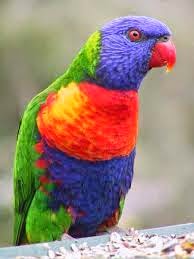
Rainbow lories (Trichoglossus haematodus) are stunning Australasian parrots from Australia (gasp!), Indonesia, Tasmania, New Guinea, Papua New Guinea, New Caledonia, Vanuatu, and the Solomon Islands. They have been introduced to Perth (Purrrrth if you’re a cat), Auckland in New Zealand, and Hong Kong.

This species has twelve subspecies in total, and they do not have any immediately noticeable sexually dimorphic (different coloration, size, etc. in the two genders) traits, but males do have more orange on their breasts and is more stocky and robust, with a more square head.

Shockingly, the beautiful tie-dye birdehz you perceive above are PESTS! Um, WHAT? This is because they eat large amounts of crops and fruit that are grown commercially.

I still consider these beautiful parrots as an awesome thing to see at a zoo. Australian farmers may not agree with me, but wutewa*. (I spelled that right! See? Yes.)


*Whatever.

December 11, 2014

My Fish Tank Tour :)

Hi everybody! Today I’m going to give a photographic tour of my 20 gallon planted fish tank, but first, a few details:

FISH:
Bronze cory (Corydoras aeneus) x 1
Common freshwater angelfish (Pterophyllum scalare) x 1
Cherry barb (Pungti titteya) x 2
Cardinal tetra (Paracheirodon axelrod) x 1 (getting four more!)
Half-banded spinyeel (Mastacembelus circumcinctus) x 1
Orange-fin loach (Yasuhikotakia modestus) x 1
Rummynose tetra (Hemigrammus bleheri) x 3
Spinecheeked loach (Pangio kuhli) x 1 (getting another!)

PLANTS:
Amazon swordplant (Echinodorus amazonicus) x 1
Golden creeping jenny (Lysimachia nummularia “Aurea”) x 2
Guppy grass (Najas marina) x 4
Java fern (Microsorum pteropus) x 2
Lucky bamboo (Dracaena sanderiana) x 5

Now for a quick tour! Here’s the tank:


It’s awesome; the water’s extremely clear and the fish are very happy. Sadly two cardinal tetras have died but I’m getting four more to keep the current one (“Swimmy”) happy. :)

The main centerpiece of the tank is a piece of lovely mopani driftwood, with eye-catching black gravel, creating a pleasing effect:


As you can see, the rummynose tetras are crowding around the driftwood, making it look prettier. :) The two Java fern plants surround the driftwood, which I did skillfully and masterfully and—

Biased? ME? Psssh.

The whole tank is comprised of two different aquascapes. On the left is a bamboo forest…


…and on the right is a “rock garden” (I just call it that ’cuz of rocks and plants. :3):


If you look behind one of the bamboo stalks, you’ll see a Hakkai-seki stone. It’s a type of Japanese aquascaping stone used in many of Takashi Amano’s aquariums. :)

Here’s the spinyeel peeking out from under a rock. See him?

“See meh?”
You can just see his head.

I hope you like my fish tank. BYE!!

Night Skies in the Ocean


This beautiful…um, rug is a Acanthozoon nigropapillosum flatworm; it is a member of the polyclad flatworms (Polycladida). Acanthozoon nigropapillosum is not only beautiful, but it’s also very widespread in the Indo-Pacific ocean, so there’s lots of hope for A. nigropapillosum in the future!

These can reach lengths of two to three inches and are found on reefs. What they eat is unknown…

…but I’m guessing cheeseburgers.

Wait, WHAT?

December 10, 2014

KoC Fact: Stings to the Brain Really Calm Bugs Down!


This beautiful creature is a jewel wasp (Ampulex compressa), aka an emerald cockroach wasp. It is so-called because it attacks insects—usually a type of cockroach called Pariplaneta americana— and stings their brains, then lays eggs inside the still-living cockroach. The young baby jewel wasps live inside the cockroach and control its brain and slowly eat the insides of the cockroach.

EWW! What?!?

I’m sorry you read that, and I’m shocked I was so…so calm about it.

Jewel wasps live all over Africa, South Asia, and the Pacific islands. The female is about 2.2 cm (22 mm) and the male is slightly smaller and lacks a stinger.

The whole “babies control bugs’ brains” thing reminds me a lot of a tropical fungus called Cordyceps, which does exactly the same thing, but it grows out of the insect (usually an ant)’s head. The weird part is that Cordyceps fungi are made into a Chinese soup called “silkie”, which also contains seahorses (Hippocampus).

Did you know there are 54 species of seahorses in the world? Find out more about the dwarf seahorses in the on December 12!

December 06, 2014

Garçon! A French Angelfish, Sil Vous Plaît!


Meet the French angelfish (Pomacanthus paru), last seen in my article on bearded fireworms (Hermodice carunculata)! These range from around the St. Paul Rocks, Ascension Island, the Gulf of Mexico, the Carribean, Brazil, the Antilles, Roatan, and Florida. Go Atlantic fish!

These live in highly populated reefs and are often seen alone or (aww) in pairs! The length is pretty big—about 17 inches—and it feeds on bryozoans, sponges, zoanthids, gorgonians, tunicates, and algae. The juveniles, on the other hand, set up cleaning stations for morays, grunts, groupers, snappers, jacks, surgeonfish, and wrasses.

Here’s what the babies look like:


Thanks for reading :3

Scary Colorful Worms.


This slightly beautiful worm is a bearded fireworm (Hermodice carunculata). It’s so pretty, right? I agree. It’s a worm from the order Polychaeta that lives in Caribbean reefs across the Antilles, the Maltese archipelago, the Mediterranean, and the waters of Cyprus. Its habitat is mostly on reefs.

Now, what’s so horrible about that?

Look out, world—the bearded fireworm is DESTROYING REEFS!!

They eat all sorts of corals, and, to make it worse, they have a sting that—well…stings?

Bearded fireworms are very slow animals, but don’t be like, “Omg haha it #canthurtme.” A) Why are you doing hashtags?; and B) YOU IDIOT IF ITS BRISTLES TOUCH YOUR SKIN THEY INJECT A NEUROTOXIN INTO YOU WHICH CAUSES BURNING AND NAUSEA!

Here’s the nice, kawaii, awesome part. The sting symptoms clear up in just about thirty minutes, and, at worst, a few hours. AND, many fish are currently doing their part to control the bearded fireworm population. These include the creole fish (Clepticus parrae, which, as a bonus, is absolutely beautiful):


the pineapplefish (Cleidopus gloriamaris)—these things are adorable, by the way; “gloriamaris” means “glory of the sea”:


and the absolutely beautiful French angelfish (Pomacanthus paru):


By the way, young P. paru look way different. I’ll save that as a surprise in a later post…